



Choosing an RC LiPo charger: power, balancing, and connectors
How to choose a reliable RC LiPo charger: output power, charge current, balancing, connectors, and safe use.
Choosing a LiPo charger is not only about its amp rating. It must support your battery cell count, deliver enough power, and balance each cell safely. This guide helps you select a suitable charger for RC cars, crawlers, boats, and aircraft.
Read the battery label first
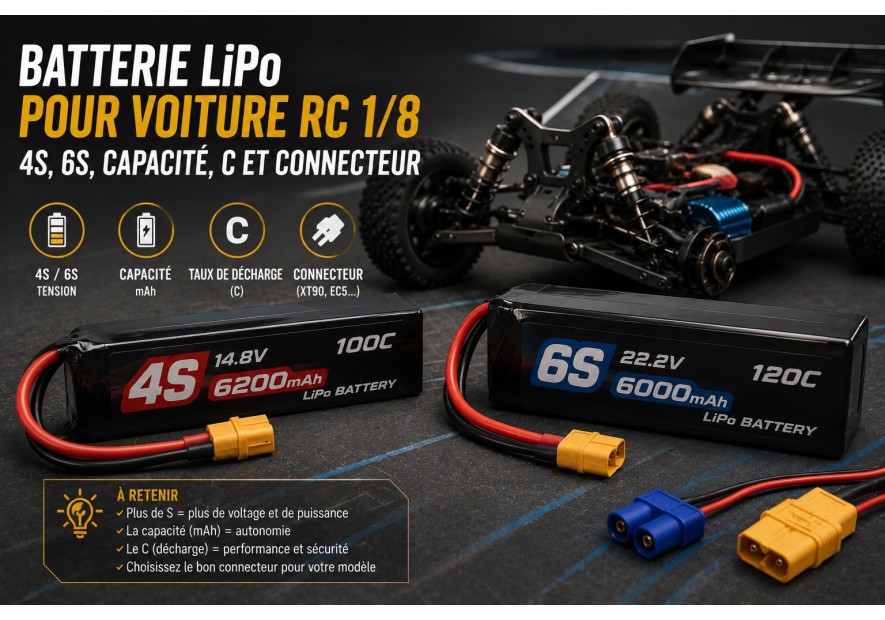
Check voltage, capacity in mAh, cell count, and main power connector before shopping. A 2S 5000 mAh pack is normally charged at 1C, or 5 A. A 3S pack with the same capacity requires more charger power because its charging voltage is higher.
Use our RC LiPo battery selection guide to size a pack correctly, then read our guide to LiPo maintenance and storage to protect it over time.
Charger power: the useful calculation
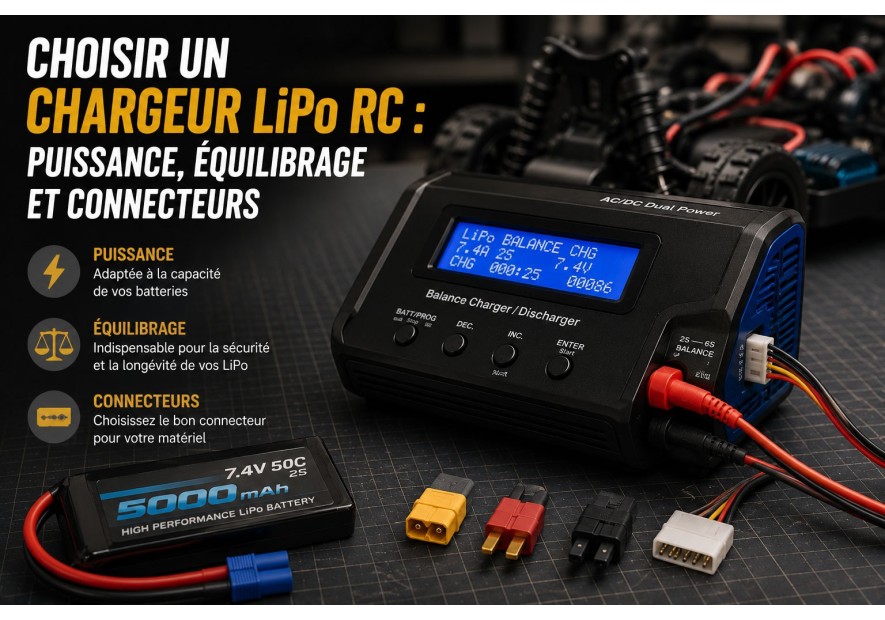
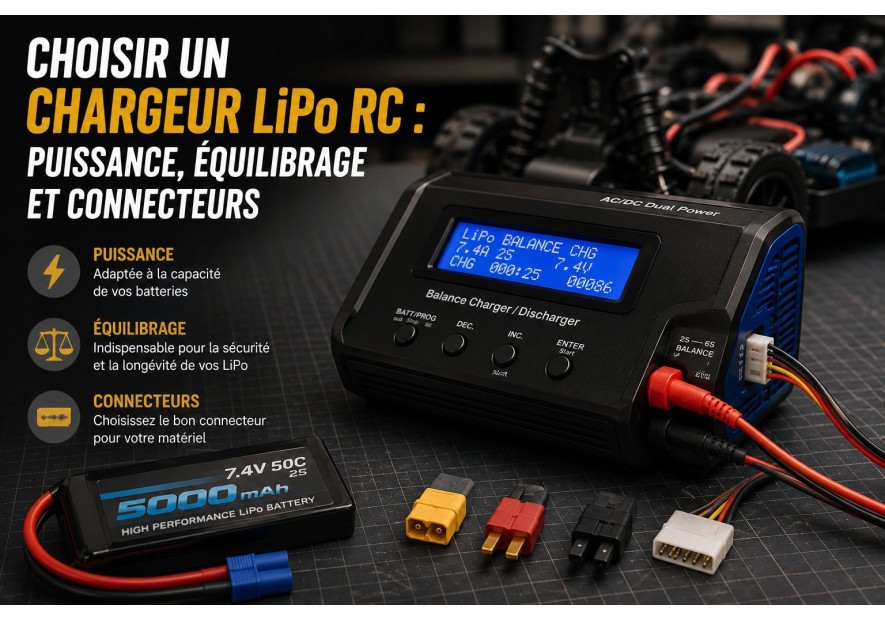
Required charger power is charging voltage multiplied by charge current. A 2S LiPo reaches 8.4 V; at 5 A it needs at least 42 W. A 3S 5000 mAh pack at 5 A needs roughly 63 W. Leave headroom: an 80 to 100 W charger is comfortable for one common 2S or 3S pack, while multiple packs, 4S batteries, or simultaneous charging need more.
Why balancing matters
The balance connector lets the charger measure each cell and correct voltage differences during charging. Use LiPo Balance mode as standard. A cell that remains markedly lower than the others is a warning sign that the pack needs attention or replacement.
- Connect both the main lead and balance lead.
- Confirm the detected cell count before starting.
- Charge on a non-flammable surface in a LiPo safety bag.
- Never leave a LiPo charging unattended.
What charge current should you use?
Unless the battery maker specifies otherwise, stay at 1C. That is 2.2 A for a 2200 mAh pack and 5 A for a 5000 mAh pack. A charger able to deliver 10 A does not mean every pack should be charged at 10 A.
Connectors and power supply
Make sure the charger works with your pack connector, or use a well-made adapter. XT60 is common, but Deans/Tamiya, EC3/EC5, and proprietary plugs remain in use. For a charger that uses an external PSU, the supply must provide at least the power the charger will draw.
Single or dual output charger?
A single-output charger suits most beginners and one RC vehicle. A dual-output model is useful for several same-day packs. Independent outputs are safer and more flexible than poorly managed parallel charging because every pack keeps its own balance program and charge current.
Buying checklist
- LiPo 2S, 3S, and 4S compatibility for your current and future models.
- Enough output power for your pack capacity and chosen charge current.
- Balance mode with individual cell-voltage display.
- Suitable connectors or safe adapters.
- Integrated power supply or correctly sized external PSU.
Conclusion
A good LiPo charger is reliable, powerful enough, and easy to configure correctly. For most 2S and 3S RC use, a balanced 80 to 100 W charger is an excellent starting point. Always match program, cell count, and charge current to the battery label.
