


Evergreen plastic profiles: complete selection guide for scale models
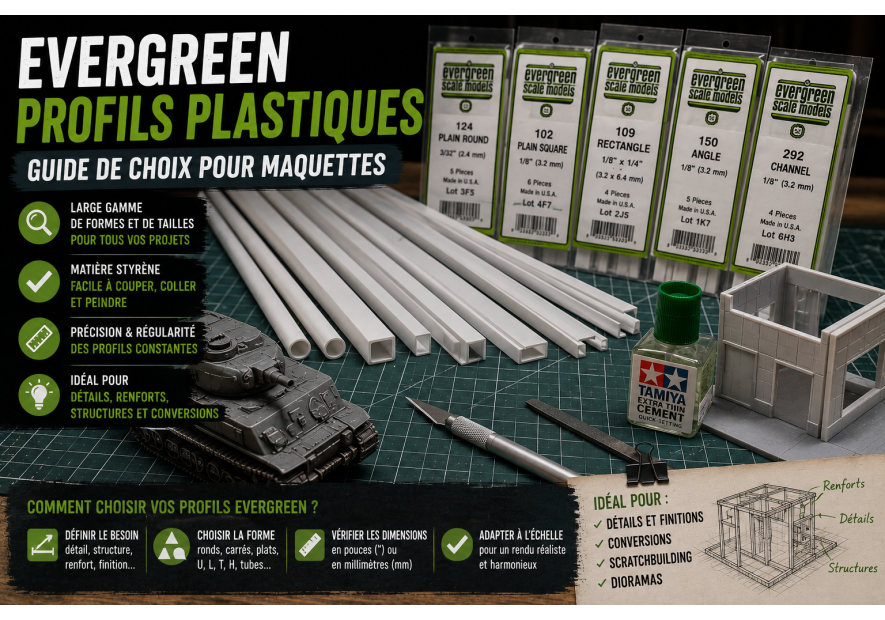
Evergreen pillar guide for scale models: selection method, decision matrix, practical scale cases and verified references.
Last updated: 2026-07-23
Quick answer
To choose Evergreen plastic profiles correctly, always start from three points: part function, best-fit section geometry, and scale size. If you are starting out, a compact set of thin rectangular strips (0.25 to 0.40 mm thickness) already covers most structural and detailing tasks.
Table of contents
- When Evergreen is better than kit parts
- 5-step selection method
- Section decision table
- Practical scale cases (HO, 1/72, 1/35)
- Recommended Evergreen references
- Common mistakes and fixes
- Sources and method
- Expert FAQ
1) When to use Evergreen instead of kit parts
Evergreen is the right option whenever a part is missing, too thick, simplified, or broken. It is also ideal for scratch-building full structures (internal frames, supports, conduits, window frames, body details, and more).
The key benefit is control over strength vs finesse: you choose the section that matches the real function instead of adapting to a generic part.
2) 5-step Evergreen selection method
- Define the part role: brace, frame, tube, decorative profile, panel.
- Pick section family: rectangular, round, U/L/T/H, sheet.
- Estimate scale dimension: real size / scale, then map to nearest stock reference.
- Check expected rigidity: if the part carries load, slightly increase section size.
- Plan assembly flow: clean cuts, controlled glue, alignment checks, sanding before finish.
3) Section decision table
| Need | Recommended section | Why | Typical use |
|---|---|---|---|
| Linear reinforcement | Rectangular strip | Reliable stiffness and easy bonding area | Internal spars |
| Piping / shafts | Round rod or round tube | Realistic circular geometry | Visible plumbing lines |
| Frames and edges | L / U profile | Repeatable and clean angles | Hatch framing |
| Surface skinning | Smooth / grooved sheet | Controlled texture and flatness | Panels and cladding |
4) Practical cases by scale
HO (1/87)
At this scale, fine sections are essential for visual credibility. 0.25 mm strips are often enough for facade details, rails and lightweight structural accents.
1/72
For aircraft and compact vehicles, 1/72 requires highly consistent cuts. Stacking smaller sections is often better than using one oversized profile.
1/35
At 1/35, slightly heavier sections are acceptable. Around 0.38 mm can deliver a good balance between handling strength and visual realism for visible structures.
5) Recommended Evergreen references (starter matrix)
- S1370100 (ref. 100) - 0.25 x 0.5 mm strip
- S1370101 (ref. 101) - 0.25 x 0.75 mm strip
- S1370102 (ref. 102) - 0.25 x 1.0 mm strip
- S1370103 (ref. 103) - 0.25 x 1.5 mm strip
- S1370104 (ref. 104) - 0.25 x 2.0 mm strip
- S1370105 (ref. 105) - 0.25 x 2.5 mm strip
- S1370106 (ref. 106) - 0.25 x 3.2 mm strip
- S1370107 (ref. 107) - 0.25 x 4.0 mm strip
- S1370108 (ref. 108) - 0.25 x 4.8 mm strip
- S1370109 (ref. 109) - 0.25 x 6.3 mm strip
- S1370110 (ref. 110) - 0.38 x 0.5 mm strip
- S1370111 (ref. 111) - 0.38 x 0.75 mm strip
6) Related references for deeper work
- Brand: Evergreen
- Main category: Evergreen plastic profiles
- Related category: Evergreen rectangular strips
- Related category: Evergreen smooth sheets
- Related guide: How to paint a scale model: complete guide
- Related guide: The different model scales explained
7) Common mistakes and how to fix them
- Mistake: choosing by visual impression only. Fix: validate structural function first.
- Mistake: oversizing for safety everywhere. Fix: use local reinforcement instead of global thickness increase.
- Mistake: too much glue. Fix: apply small controlled passes with alignment checks.
- Mistake: late finishing. Fix: deburr and sand progressively at each stage.
8) Sources and method
This pillar guide is based on live Evergreen product pages in the store, reference-level dimensions, and a workshop-first selection approach: part function, best-fit section, assembly constraints, and finish quality. Listed references were checked against the catalog at update time.
Evergreen FAQ (workshop level)
Do I need many Evergreen references to start?
No. A core set of 6 to 10 thin references already covers most beginner and intermediate builds.
How do I choose between 0.25 mm and 0.38 mm thickness?
0.25 mm is excellent for fine details and small scales. 0.38 mm is safer when the part must stay rigid during handling.
Are Evergreen profiles beginner-friendly?
Yes, if you follow a simple workflow: accurate cuts, light glue, frequent alignment checks, and gradual sanding.
What is the best use of Evergreen sheets?
Sheets are ideal for skinning, partitions and technical surfaces, then adding profile overlays for depth and realism.
How can I avoid warping during bonding?
Work on a flat surface, use temporary guides, and avoid excess glue on long thin strips.
- Related guide: Evergreen techniques: cutting, gluing and finishing
J+7 - 2026-07-24: Practical note: for a first Evergreen basket, combine one fine strip, one medium profile and one stiffer section to cover detailing, assembly and structural support.
Quick reference: Evergreen S1370100.
From profile selection to execution
After selecting profiles, move to practice with cutting/gluing techniques and complete visuals with the painting guide.
Direct category links: Evergreen profiles, tools, model painting.
To connect profile selection with finishing, this NextModelKit article on complete model painting workflow is a strong companion.
