

How to choose your first model? A complete guide for beginners
Want to get started in static model building but don't know which model to choose? Discover our comprehensive guide to selecting your first model based on your skill level, preferences, and budget. Scales, themes, essential tools, and practical advice: everything you need to know to get started smoothly and enjoy building your first model.
How to choose your first model? The complete guide for beginners
Model making is a fascinating activity that combines precision, creativity, and patience. Building a model allows you to faithfully reproduce historical vehicles, aircraft, ships, or buildings while developing numerous techniques such as assembly, painting, and weathering.
When you're starting out, it's easy to feel overwhelmed by the sheer number of models available. Size, difficulty level, scale, brands, tools… the criteria are numerous. In this guide, we'll help you choose the ideal model to get you off to the best possible start.
Why start with a model adapted to one's level?
The most common mistake is buying a highly detailed model kit simply because it's visually impressive. However, a complex model can quickly discourage a beginner.
Choosing a suitable model allows you to discover basic techniques, gain confidence and progress quickly.
What type of model should I choose?
Model airplanes
Very popular, they allow you to learn collage, painting and decal application techniques. They are often ideal for beginners.
Models of military vehicles
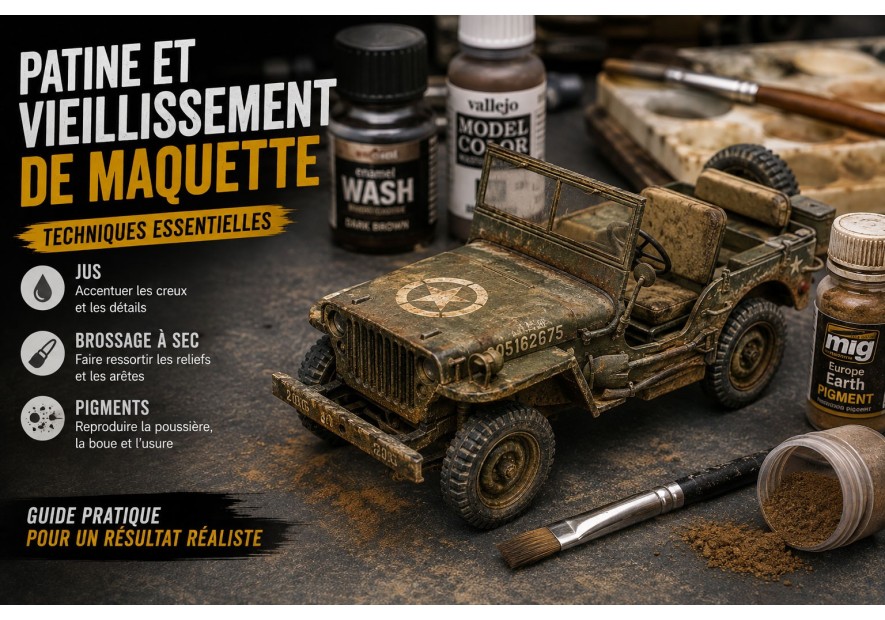
Tanks, armored vehicles and trucks offer numerous customization possibilities with very realistic aging effects.
The cars
Model cars appeal to car enthusiasts. They often require extra care to achieve a glossy paint job and perfect finishes.
The ships
Highly detailed, they generally take longer to build. They are best attempted after you've completed a few previous projects.
Which scale should I choose?
The scale represents the reduction of the model compared to the real vehicle.
- 1/72: ideal for beginners, compact.
- 1/48: excellent compromise between detail and size.
- 1/35: reference for military armored vehicles.
- 1/24: very popular for cars.
- 1/16: highly detailed models intended for enthusiasts.
How many pieces are needed for a first model?
For a first build, choose a kit containing between 50 and 150 pieces. This quantity allows you to learn without making the project too complex.
Essential tools
- Precision cutting pliers
- Model cutter
- Files and sandpaper
- Special plastic adhesive
- Tweezers
- Cutting mat
- Brushes of different sizes
With quality basic equipment, you will quickly achieve a result far superior to that obtained with conventional tools.
Should you paint your first model?
The answer is yes. Even though some models can be assembled without painting, applying the right colors adds a great deal of realism.
Acrylic paints are generally the easiest to use for beginners due to their low odor, quick drying time and easy cleanup.
Mistakes to avoid
- Choosing a model that is too complex.
- Using an unsuitable glue.
- Wanting to finish the model in a single day.
- Painting without preparation.
- Neglecting to read the instructions.
How much does a first prototype cost?
It is entirely possible to start with a reasonable budget.
- Model kit: between €20 and €50
- Basic tools: €30 to €50
- Paintings: €20 to €40
- Glue and accessories: around ten euros
For approximately €80 to €120, you have a complete set of equipment allowing you to create several models.
Why choose a recognized brand?
Specialist manufacturers offer better fitting parts, clearer instructions, and better molding quality.
Recognized brands also offer a wide selection of accessories, additional parts and suitable paints.
How to progress quickly?
- Start with simple models.
- Take your time.
- Use the right tools.
- Follow the steps in the instructions.
- Observe the work of other model makers.
- Practice regularly.
Why choose NextModelRC?
At NextModelRC , we select models, paints, tools and accessories suitable for both beginners and experienced modelers.
Our goal is to support you in your passion by offering quality products, practical advice and a wide selection of the biggest brands in model making.
Conclusion
Choosing your first model is first and foremost about enjoyment. By selecting a model suited to your skill level and using quality tools, you will quickly learn the basics of model making and enjoy creating increasingly detailed models.
The most important thing is to start with a motivating project and progress at your own pace. Each new model will allow you to acquire new techniques and develop your skills.
Related guides
What to read after your first model
Continue with the scale guide and the realistic paint guide.
Useful categories: static models to build, model painting, tools.
For deeper static-model guidance, continue on NextModelKit with the kit selection guide by skill level and budget.