


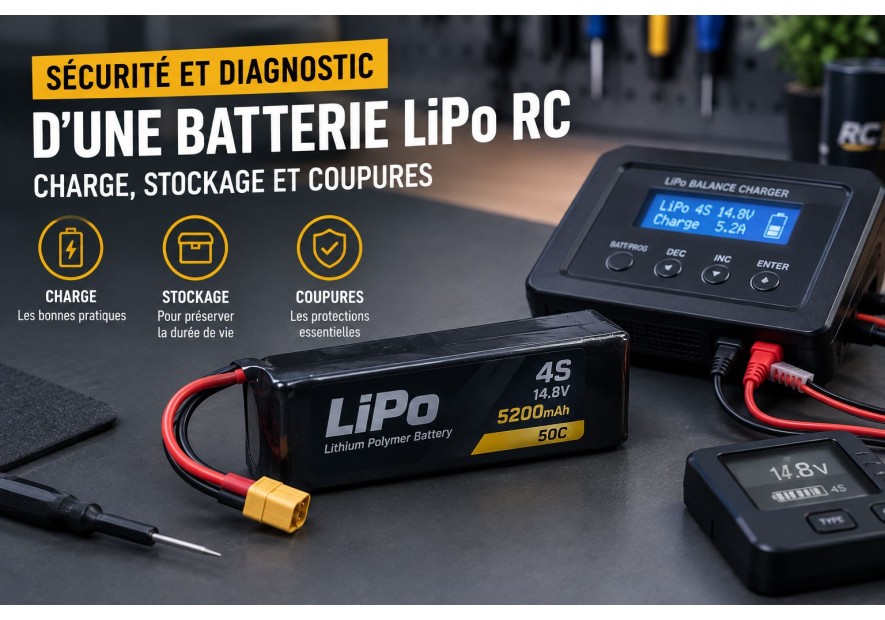
RC LiPo battery safety and diagnosis: charging, storage and cut-outs
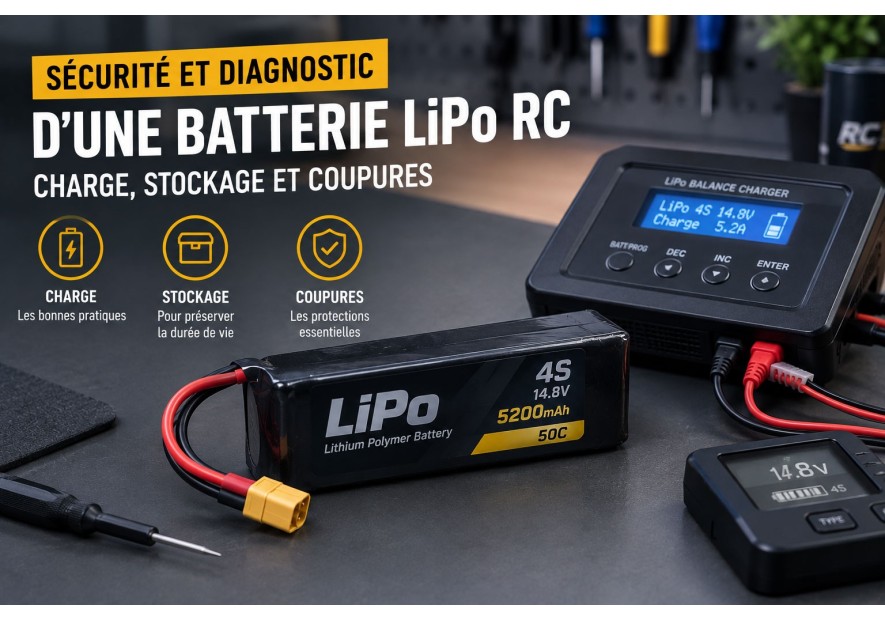
How to charge, store and diagnose a LiPo battery for a 1/8 RC car without risking the pack or electronics.
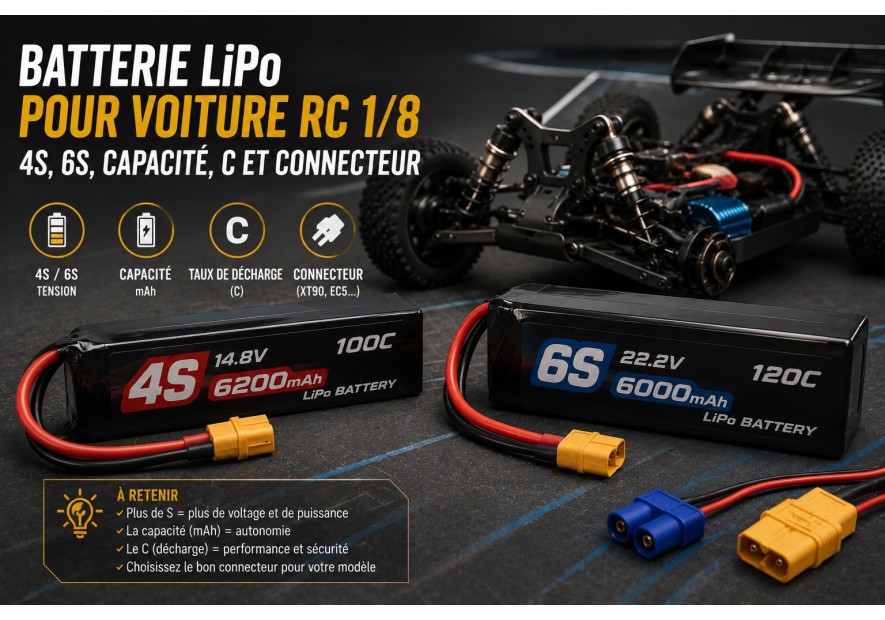
A 1/8 RC LiPo battery should not be selected by capacity alone. Voltage, cell count, ESC current demand, internal resistance, connector, battery tray dimensions and cell condition must be considered together. This guide complements our RC LiPo charger guide and our C rating and capacity guide.
Voltage: 4S does not mean only 14.8 V
A 4S LiPo has a nominal voltage of 14.8 V, reaches about 16.8 V when full and must not be discharged below the limit specified by the manufacturer and ESC. Cell count must match the power system. Never replace 4S with 6S without checking motor, ESC, cooling and drivetrain limits.
Available current and internal resistance
The theoretical current calculation is useful: a 5 Ah pack rated at 25C represents 125 theoretical amps, while 6.7 Ah at 25C represents 167.5 A. In real use, internal resistance, temperature and poor connections create voltage sag. A car that cuts out under acceleration may therefore have an ageing pack, an unbalanced cell, a resistive connector or an ESC protection event.
A diagnostic procedure before replacing the battery
- Measure total voltage after a balanced charge.
- Compare cell voltages: persistent imbalance matters more than total voltage alone.
- Inspect solder joints, balance lead, main connector and battery tray.
- Check pack and ESC temperature after a short acceleration test.
- If supported by the charger, record internal resistance cell by cell and compare similar packs.
A large increase in internal resistance under load can cause voltage sag even when open-circuit voltage looks normal. Stop using any swollen, damaged or unusually hot battery.
Charger and connectors: choose a compatible system
For a multi-brand setup, the Konect KN-X30 is an AC charger specified for 2S to 4S LiPo. The GT-Power B6 Mini is a versatile DC option; check the available power supply and cables. For two outputs, the Carson Expert DUO 2.0 is another catalogue option.
A connector alone does not define electrical compatibility. Check current rating, polarity, cable gauge and balance lead. For supervised transport or storage, use a LiPo fire-resistant safety bag.
Capacity and physical fit
Higher capacity usually increases runtime and mass. The pack must fit the tray without force and must not shift the centre of gravity excessively. Proprietary Traxxas 4S packs remain useful format examples, but the selection method also applies to Dean, XT and other connector systems: voltage, dimensions, current, balancing and ESC compatibility come first.
Diagnosing a cut-out while driving
After a cut-out, do not immediately recharge without checking the cause. Record pack voltage, each cell voltage, temperature and the exact moment of the failure. A cut-out only at full throttle may indicate thermal protection or voltage sag; a cut-out during initialization may point to a connector, balance lead or cell voltage issue. If the fault follows the battery to another compatible car, remove the pack from service.
The correct sequence is: identify 4S/6S requirements, measure cells, inspect resistance and connections, then choose a battery or charger. This avoids replacing a pack when the actual fault is in the wiring or ESC.
