

The different scales of model making explained | Complete guide
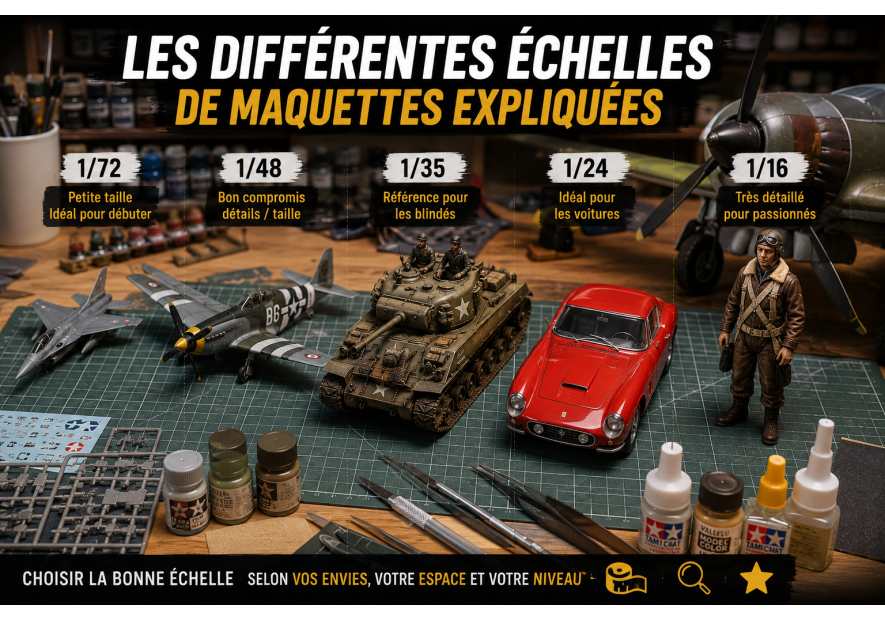
Choosing the right scale for your model is one of the first decisions you'll make before starting a project. Model size, level of detail, budget, and available space: each scale has its advantages. Discover the main scales used in static modeling and find the one that best suits your needs.
The different scales of models explained
When starting out in static model making , one of the first terms you encounter is scale . The markings 1/24, 1/35, 1/48, or even 1/72 may seem complex at first, but they are essential for choosing a model suitable for your project.
In this guide, discover the main scales used by model manufacturers, their advantages, disadvantages, and the types of models they are most often associated with.
What is the scale of a model?
Scale represents the ratio between the actual size of an object and its miniature reproduction. A 1/24 scale model means that 1 cm on the model represents 24 cm on the real vehicle.
Why is scale important?
- It determines the final size of the model.
- It influences the level of detail.
- It impacts the price of the kit.
- It facilitates the creation of coherent dioramas.
- It allows you to collect several compatible models.
The main scales
1/72: ideal for beginners
Very popular for military aircraft and certain vehicles, this scale allows you to create a beautiful collection without taking up much space. The kits are generally affordable and quick to assemble.
1/48: the perfect compromise
The 1/48 scale offers an excellent balance between size, fine detail, and ease of assembly. It is particularly popular for aircraft and certain military vehicles.
1/35: the benchmark for armored vehicles
The 1/35 scale has become the global standard for tanks and military vehicles. This scale allows for the addition of numerous accessories, figures, and highly realistic weathering effects.
1/24: essential for cars
Car enthusiasts particularly appreciate this scale which allows for faithful reproduction of the interior, engine and bodywork details.
1/16: for enthusiasts
Very large and extremely detailed, 1/16 scale models offer exceptional realism but require more time, space and budget.
What scale should I choose when I'm starting out?
For a first model, 1/72, 1/48 or 1/35 scales are generally the most accessible. They offer an excellent compromise between simplicity, cost and level of detail.
Can multiple scales be mixed?
Yes, but only in a personal collection. To create a realistic diorama, it is strongly recommended to use the same scale for the vehicles, figures, and accessories.
How to choose the right scale?
- Depending on your available space.
- Depending on your budget.
- Depending on how much time you want to spend on the assembly.
- Depending on the subject that interests you (airplanes, tanks, cars, ships...).
- Depending on your level of experience.
Why buy your model kits from NextModelRC?
NextModelRC offers a wide selection of model kits in the main scales on the market, as well as a complete selection of paints, tools, glues and accessories to support all your modeling projects.
Conclusion
Choosing the right scale is a crucial step in the success of any model-making project. By selecting a size that suits your skill level, available space, and preferences, you can fully enjoy your passion while achieving a realistic and enjoyable build.
Related guides
Scale choice and Evergreen materials
Once scale is selected, read our Evergreen profile guide and cutting and gluing techniques.
Related categories: Evergreen plastic profiles, tools.
As a practical follow-up to scale selection, NextModelKit also offers a solid guide to organizing your modeling workspace.
